types of digital marketing

Digital marketing has become one of the most important ways for businesses to connect with customers, build brand awareness, generate leads, and increase sales. Whether you run a small local business, an online store, or a growing company, understanding the different types of digital marketing can help you choose the right way to reach your target audience.

Unlike traditional marketing methods such as newspapers, television, radio, and billboards, digital marketing uses online channels and digital technologies to communicate with potential customers. These channels include search engines, social media platforms, websites, email, online advertising, and more.

But digital marketing is not just one marketing method. It includes several strategies, and each one serves a different purpose.

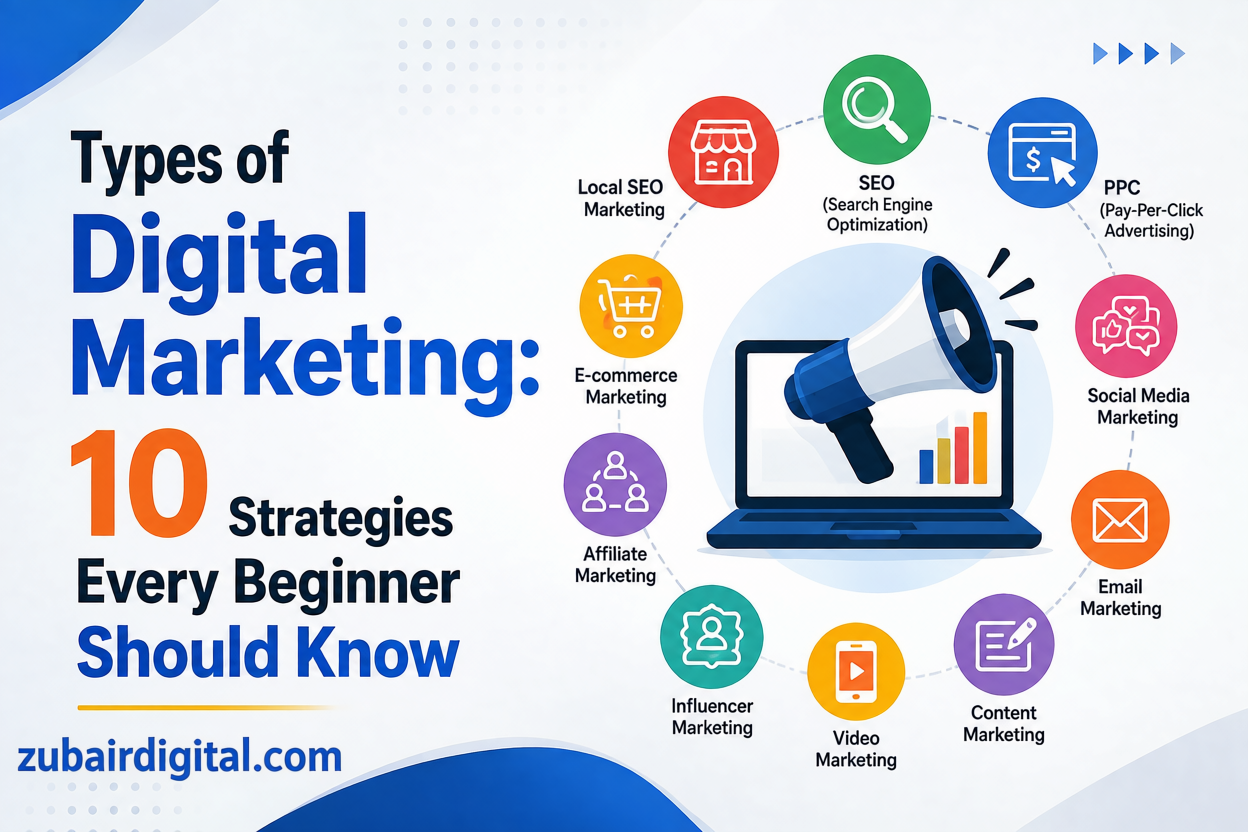
In this guide, we will explore the 10 major types of digital marketing, how each strategy works, its benefits, and when beginners should consider using it.

What Are the Different Types of Digital Marketing?

The types of digital marketing are different online marketing strategies businesses use to attract, engage, convert, and retain customers.

Some strategies focus on bringing visitors to a website through organic search, while others use paid advertising, social media, email, or valuable content to reach an audience.

The most common digital marketing types include:

  1. Search Engine Optimization (SEO)
  2. Search Engine Marketing and PPC
  3. Content Marketing
  4. Social Media Marketing
  5. Email Marketing
  6. Affiliate Marketing
  7. Influencer Marketing
  8. Video Marketing
  9. Mobile Marketing
  10. Display Advertising

These strategies can be used individually, but businesses often combine several digital marketing channels to create a stronger overall marketing strategy.

For example, a business might use SEO to attract organic traffic, content marketing to educate visitors, social media marketing to build engagement, and email marketing to stay connected with existing customers.

1. Search Engine Optimization (SEO)

Search Engine Optimization, commonly called SEO, is one of the most important types of digital marketing. It focuses on improving a website’s visibility in search engine results so that potential customers can discover the business organically.

When someone searches Google for a product, service, question, or solution, search engines analyze thousands of pages to determine which results are most relevant. SEO helps businesses improve their chances of appearing in those results.

How Does SEO Work?

SEO generally involves optimizing different parts of a website, including:

  • Keyword research
  • Helpful and relevant content
  • Page titles and headings
  • Meta descriptions
  • Internal linking
  • Website structure
  • Page speed
  • Mobile usability
  • Backlinks
  • Technical SEO

The goal is not simply to insert keywords into a page. Modern SEO focuses on creating useful content that satisfies search intent and provides a good experience for visitors.

How SEO Helps Businesses

A successful SEO strategy can help businesses:

  • Increase organic traffic
  • Improve search rankings
  • Build brand visibility
  • Generate leads
  • Reach people actively searching for solutions
  • Create long-term website traffic

For example, if you operate a digital marketing website and publish a useful guide about SEO for beginners, someone searching for information about SEO may discover your article through Google.

SEO can take time to produce significant results, but it can become a valuable long-term source of traffic.

2. Search Engine Marketing (SEM) and PPC

Search Engine Marketing involves promoting websites through search engine advertising. One of the most common forms is pay-per-click (PPC) advertising. Unlike SEO, where businesses aim to earn organic rankings, PPC allows advertisers to pay for visibility in search results.

Google Ads is one of the most widely used platforms for search advertising.

What is PPC Marketing?

With PPC advertising, advertisers generally pay when someone clicks on their advertisement. Businesses can create campaigns around specific keywords and target people based on factors such as location, interests, and search behavior.

For example, a company selling laptops could create an advertisement targeting searches related to buying laptops online.

SEO vs PPC

The biggest difference between SEO and PPC is how traffic is acquired.

SEO

  • Focuses on organic visibility
  • Usually takes longer to build
  • Can generate sustainable traffic
  • Does not require paying for every individual click

PPC:

  • Uses paid advertising
  • Can generate traffic quickly
  • Requires an advertising budget
  • Allows detailed audience and campaign targeting

Neither approach is automatically better. The right choice depends on the business goal, budget, competition, and timeline. Businesses that need immediate visibility may use PPC, while companies looking to build long-term organic traffic may invest more heavily in SEO.

3. Content Marketing

Content marketing is another major type of digital marketing. Instead of directly promoting a product in every interaction, content marketing focuses on creating useful information that attracts and educates a target audience.

Content can take many forms, including:

  • Blog posts
  • How-to guides
  • Tutorials
  • Ebooks
  • Infographics
  • Case studies
  • Checklists
  • Original research
  • Educational videos

Why Is Content Marketing Important?

People often search online before making a purchasing decision. They may want to understand a problem, compare solutions, research products, or learn how something works. Useful content allows a business to become a helpful resource during that customer journey.

For example, a company selling cybersecurity software could publish an article explaining common online security risks. Someone searching for that information may discover the company through the content and eventually become a potential customer. Content marketing can support SEO, increase website traffic, build trust, and help generate leads.

Content Marketing and SEO

Content marketing and SEO often work together. SEO helps people discover content through search engines, while content provides useful information that satisfies their search intent. This makes high-quality content an important part of many successful online marketing strategies.

4. Social Media Marketing

Social media marketing involves using social media platforms to promote a brand, communicate with customers, distribute content, and build an online community.

Popular platforms include:

  • Instagram
  • Facebook
  • LinkedIn
  • YouTube
  • X
  • TikTok

The right platform depends on the target audience and the type of business.

Organic vs Paid Social Media Marketing

Social media marketing can be divided into two broad approaches. Organic social media marketing involves creating and publishing content without directly paying for advertising. Examples include posts, reels, stories, educational content, and community engagement.

Paid social media marketing involves running advertisements to reach a specific audience.

Businesses can use social media to:

  • Increase brand awareness
  • Engage with customers
  • Promote products and services
  • Share educational content
  • Drive website traffic
  • Generate leads
  • Build a community

For beginners, the most important step is not trying to be active on every platform. Instead, understand where your target audience spends time and focus your efforts there.

5. Email Marketing

Email marketing is a digital marketing method that uses email communication to build relationships with subscribers and customers. Unlike social media, where businesses depend on a platform’s algorithm to reach people, email allows businesses to communicate directly with people who have voluntarily joined their mailing list.

Common Types of Email Campaigns

Businesses can use email for:

  • Welcome emails
  • Newsletters
  • Promotional campaigns
  • Product announcements
  • Educational content
  • Follow-up emails
  • Customer retention campaigns
  • Abandoned-cart reminders

For example, an online store could send customers useful product recommendations and special offers based on their previous interactions.

Why Email Marketing Still Matters

Email marketing can be particularly useful for customer retention and repeat purchases. It also allows businesses to personalize communication and segment audiences according to their interests or behavior.

A successful email strategy focuses on delivering useful information rather than sending constant promotional messages.

6. Affiliate Marketing

Affiliate marketing is a performance-based digital marketing strategy where individuals or organizations promote another company’s products or services and receive a commission when their promotional activity generates a qualifying sale or action.

How Affiliate Marketing Works

The process usually involves three main parties:

Merchant: The business or brand that offers the product or service being promoted.

Affiliate: The person or organization promoting the product.

Customer: The person who purchases or completes the desired action.

For example, a technology blogger might review a laptop and include an affiliate link to an online retailer. If a reader purchases the laptop through that link and the program’s conditions are met, the blogger may receive a commission.

Affiliate marketing is popular among bloggers, content creators, publishers, and website owners.

However, successful affiliate marketing requires trust. Content creators should clearly explain when links are affiliate links and focus on recommending products that are genuinely useful to their audience.

7. Influencer Marketing

Influencer marketing connects brands with niche-focused creators who have built a loyal and engaged audience around their area of expertise.

Instead of communicating directly with a broad audience through traditional advertising, brands work with creators who have already built relationships with their followers.

Types of Influencers

Influencers are often categorized according to audience size, although definitions can vary between platforms and marketing agencies.

Common categories include:

  • Nano influencers
  • Micro influencers
  • Macro influencers
  • Celebrity influencers

A small creator with a highly engaged niche audience may sometimes be more valuable for a campaign than a large creator with a broad but less relevant audience.

How Businesses Use Influencer Marketing

Brands may collaborate with influencers for:

  • Product reviews
  • Sponsored content
  • Tutorials
  • Product demonstrations
  • Brand awareness campaigns
  • Social media promotions
  • Event coverage

The key is choosing an influencer whose audience is relevant to the product or service.

8. Video Marketing

Video marketing involves creating and sharing engaging visual content to inform, entertain, showcase products, and influence potential customers.

Video has become an important part of online marketing because it can communicate information quickly while combining visuals, audio, demonstrations, and storytelling.

Types of Marketing Videos

Businesses can create:

  • Product demonstrations
  • Tutorials
  • Customer testimonials
  • Explainer videos
  • Educational videos
  • Product reviews
  • Short-form videos
  • Behind-the-scenes content

Platforms such as YouTube, Instagram, TikTok, and LinkedIn provide different opportunities for video marketing.

For example, a software company could create a short tutorial showing users how to complete a common task. A product-based business might create a demonstration showing how its product works.

Why Video Marketing Works

Video can help businesses explain complex ideas, demonstrate products, build trust, and increase engagement. However, expensive equipment is not always necessary. Beginners can start with simple, useful videos and improve their production quality over time.

The most important factor is whether the content provides value to the intended audience.

9. Mobile Marketing

Mobile marketing uses smartphones, tablets, and other handheld devices to connect businesses with their target customers. Since people spend a significant amount of time using mobile devices, businesses need to consider the mobile experience when developing their digital marketing strategy.

Common Mobile Marketing Methods

Mobile marketing can include:

  • SMS marketing
  • Push notifications
  • Mobile applications
  • Mobile advertising
  • Mobile-friendly websites
  • Location-based marketing

For example, a retail business might send an SMS notification about a limited-time offer. A mobile application could send customers personalized notifications about new products or promotions.

Why Mobile Marketing Is Important

A large percentage of online activity happens through mobile devices. Therefore, businesses should ensure their websites, landing pages, emails, advertisements, and content work properly on smaller screens. Mobile optimization is not just a separate marketing tactic. It should be considered across the entire digital customer journey.

10. Display Advertising

Display advertising involves showing visual advertisements across websites, applications, and other digital properties. Display ads commonly appear as banners, images, responsive advertisements, or video-based placements.

How Display Advertising Works

Advertisers can target audiences based on different factors, depending on the advertising platform and campaign setup.

Display advertising can be used for:

  • Brand awareness
  • Product promotion
  • Website traffic
  • Remarketing
  • Lead generation
  • Customer acquisition

For example, someone might visit an online store without making a purchase. A business may later use remarketing advertising to show that person relevant advertisements while they browse other websites or platforms. Display advertising can help businesses remain visible to potential customers after their initial interaction.

How to Find the Most Effective Digital Marketing Method

With so many digital marketing channels available, beginners often ask an important question: Which strategy should I start with?

There is no single answer because the right strategy depends on your business, audience, goals, resources, and industry. Start by considering these factors.

1. Define Your Marketing Goal

First, decide what you want to achieve.

Your goal could be:

  • Increasing website traffic
  • Generating leads
  • Increasing sales
  • Building brand awareness
  • Improving customer retention
  • Growing an online community.

Your goal should influence the strategy you choose.

2. Understand Your Target Audienceg Text Here

Find out who your ideal customers are and where they spend their time online.

For example, a B2B company may find LinkedIn valuable, while a visual consumer brand may benefit more from Instagram or YouTube.

3. Consider Your Budget

Some strategies require significant advertising budgets, while others can be started with relatively limited financial resources.

SEO and content marketing may require more time and effort, whereas PPC can provide faster visibility but requires ongoing advertising spend.

4. Think About Your Timeline

For faster audience reach, paid advertising can provide an effective solution.

If your goal is long-term organic visibility, SEO and content marketing may be more suitable.

The best digital marketing strategy often combines short-term and long-term approaches.

5. Track Your Results

Digital marketing is measurable. Businesses can monitor metrics such as:

  • Website traffic
  • Click-through rate
  • Conversion rate
  • Leads
  • Sales
  • Engagement
  • Return on investment
  • Customer acquisition cost

Use these insights to understand what is working and where your strategy needs improvement.

What Type of Digital Marketing Is Most Suitable for Beginners?

There is no universal “best” type of digital marketing.

The best approach varies based on the results you want to achieve.

Digital Marketing Type
Best For
General Cost Level
Typical Results
SEO
Organic traffic
Low to Medium
Long-term
PPC
Quick visibility
Medium to High
Short-term
Content Marketing
Education and trust
Low to Medium
Medium to Long-term
Social Media Marketing
Engagement and awareness
Low to Medium
Short to Long-term
Email Marketing
Retention and communication
Low to Medium
Short to Medium-term
Affiliate Marketing
Performance-based promotion
Variable
Performance-dependent
Influencer Marketing
Audience reach and awareness
Variable
Campaign-dependent
Video Marketing
Education and engagement
Low to High
Short to Long-term
Mobile Marketing
Mobile audiences
Variable
Campaign-dependent
Display Advertising
Awareness and remarketing
Medium to High
Short to Medium-term

Digital Marketing Strategy vs Digital Marketing Tactics

While the two terms may sound similar, they do not refer to exactly the same concept.

A digital marketing strategy is the overall plan for achieving a marketing objective.

Tactics are the specific actions used to execute that strategy.

For example:

Goal: Increase organic website traffic.

Strategy: Build a long-term SEO and content marketing program.

Tactics: Conduct keyword research, create helpful blog content, optimize pages, improve internal linking, and earn relevant backlinks.

Understanding this difference can help beginners avoid randomly posting content or running advertisements without a clear objective.

Benefits of Using Multiple Digital Marketing Strategies

Businesses do not always have to choose only one digital marketing method. Combining complementary strategies can create a stronger marketing system.

Wider Audience Reach

Different channels allow businesses to reach people at different stages of the customer journey.

More Traffic Sources

A website that depends entirely on one traffic source may become vulnerable if that source changes. Combining SEO, social media, email, and other channels can create multiple sources of visitors.

Better Brand Visibility

Consistent activity across relevant digital channels can make a business easier for potential customers to discover.

More Opportunities to Generate Leads

Different channels can attract different types of prospects. Content may attract people researching a problem, while PPC may reach someone ready to purchase.

Better Customer Engagement

Social media, email, video, and content can help businesses communicate with their audience beyond a single transaction.

Measurable Performance

Digital marketing provides access to analytics that can help businesses understand how campaigns perform and where improvements are needed.

Frequently Asked Questions?

What are the 10 types of digital marketing?

The 10 commonly used types include SEO, PPC, and search engine marketing, content marketing, social media marketing, email marketing, affiliate marketing, influencer marketing, video marketing, mobile marketing, and display advertising.

Which kind of digital marketing is most effective one?

There is no single strategy that is most effective for every business. SEO may be valuable for long-term organic traffic, PPC can provide faster visibility, while social media, email, and content marketing can support engagement and customer relationships.

What is the most important type of digital marketing for beginners?

SEO and content marketing can be useful starting points for beginners who want to learn how websites attract organic traffic. However, the best starting point depends on the person’s goals, audience, industry, and available resources.

Is SEO a type of digital marketing?

Yes, search engine optimization plays a major role in digital marketing strategies. It focuses on improving a website’s visibility in organic search engine results.

Difference between SEO and SEM?

SEO focuses on earning organic visibility in search engines, while SEM uses paid advertisements to generate traffic. SEO generally takes longer to build, whereas SEM can provide visibility more quickly when campaigns are properly configured.

How many types of digital marketing are there?

There is no universally fixed number because digital marketing continues to evolve and different organizations categorize strategies differently. The 10 methods discussed in this guide represent some of the most common and widely used approaches.

Conclusion

Understanding the types of digital marketing is an important first step for anyone learning online marketing.

From SEO and content marketing to social media, email, PPC, influencer marketing, video, mobile, affiliate, and display advertising, each strategy has a different role in reaching and engaging an audience.

You do not need to become an expert in every digital marketing channel at once. Start by understanding your audience, define your goal, choose the channels that make the most sense for your situation, and measure your results consistently.

As you gain experience, you can combine different digital marketing strategies to create a stronger and more sustainable online presence.

If you are completely new to the subject, start with our beginner’s guide to digital marketing to understand the fundamentals before exploring individual strategies in greater depth.